
On this page
Waxing and shaving aren't the same thing.
Shaving cuts hair at the skin's surface. Waxing removes the visible hair from the root. That's why the two methods can feel different as hair grows back.
Shaving
Hair is cut at the skin surface, leaving a blunt tip. You may notice stubble within days, depending on how quickly your hair grows.
Waxing
Hair is removed from the root, so it generally takes longer to become visible again. Some people find that new growth feels softer and is less bothersome than shaving stubble.
Does waxing make hair disappear permanently? No. With repeat appointments, some people notice finer-feeling, sparser, or less noticeable hair and can go longer between visits. Others don't see much change. Your hair type, hormones, age, and growth cycle all play a role.
Where can you get waxed?
You don't have to know exactly which service name to choose. Start with the area you want to address, and we'll help you find the appropriate appointment.
Underarms
Many clients choose underarm waxing to avoid frequent shaving and the feel of short stubble. Underarm skin can be sensitive, especially right afterward, so we talk about deodorant and exercise before you leave.
Legs
From a smaller area to more extensive leg waxing, we work with your hair growth and skin condition. You may find it easier to keep up with regular waxing than daily or near-daily shaving.
Face & detail
Brows, upper lip, chin, sideburns, and other facial options are listed in our service menu. Facial skin can be especially reactive to retinoids and acne treatments, so product history matters.
Arms, chest, back & body
Body waxing can help with everyday grooming, personal preference, or athletic needs. We adjust the approach to the area, amount of hair, and how your skin responds.
Bikini, Strip Bikini & Brazilian
Three different amounts of hair removal, with an explanation of where the lines are drawn. We always confirm how much you want removed before proceeding.
Ingrown hairs & follicular care
Sometimes your concern is the skin around the hair, not removal itself. If you have recurring bumps or ingrowns, we can discuss what is appropriate within aesthetic scope.
For specific areas, availability, appointment lengths, and current prices, use Clinical Grooming & Waxing on our Services page →.
Not all wax is the same.
A Brazilian, a leg wax, and an eyebrow wax don't all call for the same product. At The Body Mechanist, we choose among three professional waxes based on the area, your hair, and how your skin responds.
Locally sourced hard wax
Where we use it: Brazilian and intimate waxing, where hair is often coarser.
Our locally sourced hard wax is designed to grip coarse hair while adhering less to the skin. It sets around the hair and lifts away on its own, without a paper strip.
Because it grips hair more than the skin, we may be able to go over a spot again if a few hairs remain. We check the skin first and never keep waxing an area that looks irritated or compromised.
Honey wax
Where we use it: Legs, arms, and larger body areas.
Honey wax is a soft, strip wax. It spreads in a thin layer, grips the hair and some surface skin cells, and is removed with a paper strip. That also gives it an exfoliating effect.
For legs and arms, we often use a Speed Stick applicator rather than applying every section with a wooden spatula. In our practice, this can cut application time by about half compared with our traditional applicator method.
Cream wax
Where we use it: Face and underarms.
Our cream strip wax is the gentler-feeling formula we choose for these smaller, more delicate areas. It can pick up finer hairs while still using a paper strip for removal.
Like honey wax, cream wax adheres to both hair and the skin's surface. Even with a gentler formula, we take care not to apply it repeatedly to the same freshly waxed spot.
We never double-dip. Once an applicator touches your skin, it does not go back into our wax.
What should you expect as hair grows back?
Not every hair grows at the same time. Hair follicles cycle through growing, transitioning, and resting phases. That is one reason you may see scattered new hairs before the rest of the area has grown back.
- The first few appointments may feel different. If you've been shaving, some hairs may be very short while others are ready to wax. Results usually become easier to maintain once more hairs have had time to grow.
- Regrowth may feel softer. Unlike freshly cut shaving stubble, new hair emerges with a natural tip. It may feel less prickly.
- Some clients notice less hair over time. Repeated removal can be associated with finer or less noticeable growth, but results vary and shouldn't be expected to be permanent.
- You may find a comfortable routine. Many people book roughly every three to six weeks, depending on the area and their individual regrowth. Your hair doesn't follow a calendar, so we plan around what we see.
What happens during a wax?
You can ask questions, change your mind, or ask us to stop at any point. We explain what we're doing before we begin.
- We check your skin and history. We ask about recent treatments, medications, topical products, irritation, and your preferences before selecting the approach.
- We prepare the area. We use pre-wax oil or powder when appropriate for your skin, then choose hard, honey, or cream wax according to the area, hair texture, and skin condition.
- We remove the wax carefully. You will usually feel a pulling sensation followed by a brief stinging feeling as the hair comes out. We apply pressure immediately after each pull to help with comfort.
- We finish with aftercare. We explain what is normal, what to avoid for the rest of the day, and how to care for your skin until the next appointment.
For intimate waxing: We provide an intimate wipe, then ask you to lie on the table with a towel over your lap. If it's your first visit, we explain the full process first. We begin in a way that lets you decide to stop at a Bikini or Strip Bikini instead of continuing to a Brazilian. You are always in control of how far we go.
How to prepare for waxing.
A little preparation makes it easier for the wax to grip the hair and for us to assess your skin accurately.
- Let your hair grow. We need at least the length of a grain of rice. About two weeks after shaving works for many people, but the actual hair length matters more than the calendar.
- Come with clean skin. Skip heavy lotions and oils on the treatment area the day of your appointment.
- Tell us about active skin products. Retinoids, exfoliating acids, and some acne treatments can make waxing inappropriate or require changes to the plan.
- Let us know about irritated skin. Sunburn, broken skin, an active rash, or a suspected infection may mean we need to postpone.
- Wear what feels comfortable. Loose clothing is particularly helpful after body and intimate waxing because it reduces friction on freshly waxed skin.
What to do after your wax.
A little redness, warmth, or tenderness can happen, especially if this is your first wax. Freshly waxed skin deserves a calm day.
For the rest of the day
- Avoid sweating and strenuous workouts. Heat, sweat, and friction can aggravate freshly waxed skin.
- Skip sex after intimate waxing. Avoid sexual activity and friction against the treated area for the rest of the day, and longer if your skin remains tender.
- Keep clothing loose. Avoid tight waistbands, leggings, or anything that repeatedly rubs the treated skin.
- Go easy on products. Avoid scented or irritating products, including deodorant on tender underarms, until the skin feels comfortable.
For the first 24 hours
- Avoid tanning, hot tubs, hot baths, and swimming.
- Avoid scrubs, exfoliating mitts, acids, and other products that sting or irritate the area.
- Be gentle with washing and pat the skin dry.
- Do not shave between waxing appointments if you want to maintain a regular waxing routine.
If redness or tenderness is worsening rather than settling, or you develop marked swelling, spreading warmth, or drainage, seek appropriate medical advice.
Ingrown hairs: what you can do at home.
An ingrown hair develops when a growing hair curls back or becomes trapped beneath the skin. Friction, dead skin buildup, and individual hair texture can all be part of the picture.
To help prevent them
- Wait until sensitivity is gone. Don't exfoliate newly waxed, red, or tender skin.
- Exfoliate gently once your skin is calm. A clean, soft sloughing mitt, loofah sponge, or washcloth can help lift dead surface skin so new hair has a clearer path outward. Use light pressure, not vigorous scrubbing.
- Consider a product made for ingrown-prone skin. Some clients use Tend Skin or similar products. Follow the product instructions, patch-test first, and don't use it on broken or irritated skin or on internal/mucosal areas. Stop if it stings or inflames your skin.
- Limit repeated friction. Tight clothing can aggravate bumps, particularly along the bikini line and underarms.
If you already have an ingrown hair
- Pause shaving, waxing, and exfoliation directly over an inflamed bump.
- Apply a warm, damp washcloth for 10–15 minutes to help soften the skin.
- Keep the area clean. Don't squeeze, dig, pick, or try to cut the hair free.
- If it isn't improving, or becomes more painful, warm, swollen, spreading, or drains pus, ask a medical professional to evaluate it.
Bikini, Strip Bikini & Brazilian.
Different names mean different amounts of hair removed. This visual is a general guide. We confirm the boundaries with you before starting, and you can change your mind about how much you want removed.
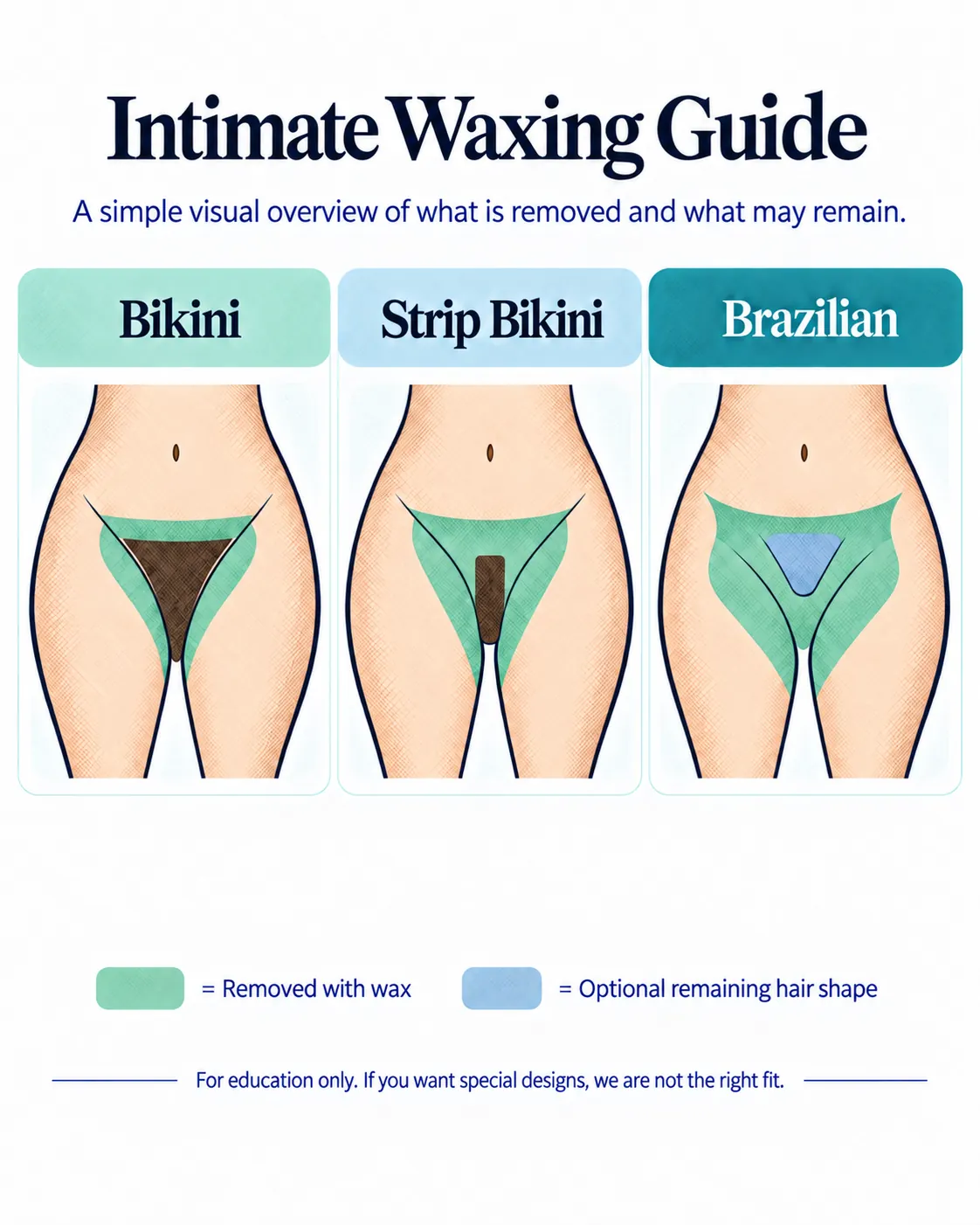
Bikini 15 minutes
We remove hair just inside the underwear line along the sides and top, including approximately one inch below the thigh crease. Hair remains in the center.
Strip Bikini 15–30 minutes
We leave a central strip about two finger-widths wide. You choose how low to take the hair at the top. No hair is removed beyond the agreed service boundaries.
Brazilian 20–45 minutes
Hair removal from front to back, with your choice of leaving a triangle, leaving a strip, or removing it all. We don't create decorative designs.
See prices and book the waxing service that's right for you →
When should you wait before waxing?
Certain medications, products, and skin conditions can increase the chance of skin injury. Please tell us about them before your appointment.
- Isotretinoin (Accutane): We cannot wax you while you're taking isotretinoin or for at least six months after your last dose.
- Retinoids and active treatments: Tell us if you use tretinoin, Retin-A, Differin, Tazorac, retinol, glycolic or salicylic acids, benzoyl peroxide, or other exfoliating products, especially where you want to be waxed. We will discuss whether it's appropriate to proceed.
- Compromised skin: We won't wax over sunburned, broken, infected-looking, or significantly irritated skin.
- Recent skin procedures or reactions: Let us know about recent peels, resurfacing, or unusual reactions to waxing.
We may recommend rescheduling or consulting a medical professional if waxing isn't appropriate for your skin that day.
Common waxing questions.
Do you use the same wax everywhere?
No. We use locally sourced hard wax for intimate services, honey strip wax on many larger areas such as legs and arms, and our cream strip wax for face and underarms. We choose the product for your hair and skin, not just the body part. See how our waxes differ →
Why won't you wax the same spot twice with honey or cream wax?
These strip waxes adhere to skin as well as hair and can lift surface skin cells. Waxing the same spot again can irritate or damage the skin. Hard wax may allow another careful pass, but only if the skin remains healthy.
Does waxing hurt?
Most people feel a pull followed by a short sting when the hair comes out. We apply pressure right away to help with comfort. Sensation varies from person to person and between body areas.
How long does a wax last?
Many people notice several weeks of smoother skin, but the length of time varies with the treatment area and your own hair-growth cycle.
Is my hair long enough?
We need at least a grain-of-rice length. If you have been shaving, allow enough time for the hair to grow before you book.
Can I wax my underarms if I wear deodorant daily?
Yes, but arrive without heavy product on the treatment area. Afterward, wait until your underarms are no longer sensitive before applying irritating or fragranced deodorants.
Can I stop during a Brazilian wax?
Yes. We work in an order that makes it possible to stop at a Bikini or Strip Bikini. You choose how much hair is removed, and consent is ongoing.
Do you wax everyone the same way?
No. Skin condition, hair type, the area being waxed, your comfort, medications, and your preferences all guide what we do.
Where can I find the prices?
Every waxing service and its current price is listed on Services & Pricing →. Booking is through Vagaro.
Ready when you are.
You don't need to arrive knowing everything about waxing. We'll explain your options, respect your boundaries, and make sure you understand how to care for your skin afterward.